


Syllabus: GS2/Judiciary; E-Governance
Context
- The Supreme Court set aside an National Company Law Tribunal (NCLT) judgment, as it found that the tribunal had relied on non-existent, fake and hallucinated judgments/precedents generated using AI.
About
- The case underscored wider concerns about the use of AI in legal adjudication and stressed that although AI can assist the process, adjudication must remain under the absolute control of human decision-makers.
- It directed that the apex bar body must take up this issue with utmost seriousness and prescribe a guiding principle to prevent such occurrences, along with the disciplinary action.
Recent SC Draft Regulations on AI Use in Judiciary
- It permits the use of AI for administrative functions such as case management, preparation of cause lists, scheduling of hearings, transcription of court proceedings and translation of judgments.
- AI systems cannot be used for “risk scoring” in court processes, this includes assessing flight risk, predicting recidivism, evaluating bail eligibility, or determining the credibility of parties or witnesses.
- The processing of personal data through AI systems shall be governed by the provisions of the Digital Personal Data Protection Act, 2023.
- AI systems must not perpetuate bias on grounds of race, religion, caste, sex, gender, disability, language, economic status, or any other ground prohibited under the Constitution.
- AI-assisted judicial systems should not “widen digital divides” and must remain accessible to all stakeholders.
- To supervise the adoption of AI in the judiciary, it proposes the creation of a full-time “apex body” at the Supreme Court.
Use of AI in India’s Justice System
- In the Supreme Court, High Courts, National Informatics Centre (NIC) AI tools are now assisting various functions such as:
- Transcription of oral arguments,
- Translation of judgments,
- Identification of defects in e-filing,
- Legal research, and
- Metadata extraction.
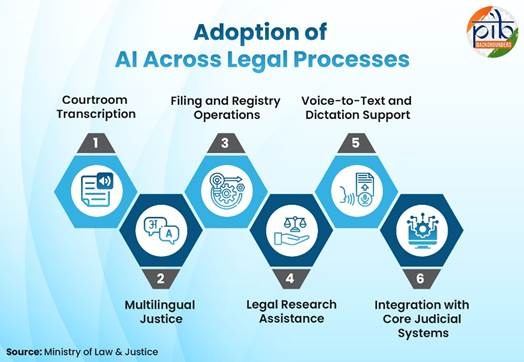
- Over the past decade, courts have moved from basic computerisation to nationwide digital platforms, real-time data systems, virtual courts and multilingual judgment access.
- Latest technologies like AI and its subsets Machine Learning (ML), Optical Character Recognition (OCR), Natural Language Processing (NLP) are being used in the e-Courts software applications developed under the eCourts Project.
Significance of Use of AI in Judiciary in India
- Backlog of Cases: India’s judicial system faces a backlog cases, undermining public trust in timely justice.
- AI can streamline case management, reduce backlog, and speed up judicial processes.
- Overcrowding in Prisons: Indian prisons have been housing more inmates than their capacity for decades now, AI can streamline the complaint registration process, track investigations, flag necessary actions, and assess investigation quality.
- Translation and Accessibility: India has 22 scheduled languages and hundreds of dialects. AI-powered translation can make judicial documents and judgments accessible across linguistic barriers.
- The SUVAAS (Supreme Court Vidhik Anuvaad Software) project has translated thousands of judgments into regional languages.
- Enhanced Accuracy: AI can prevent neglect of crucial evidence and ensure a more meticulous and reliable criminal justice process.
- Improving Access to Justice: AI chatbots and virtual assistants can help litigants, especially those without legal representation, navigate procedures, track case status, and file petitions.
Concerns/Challenges
- Bias and Dependence: AI-enabled legal research may show search bias, excluding relevant precedents.
- Over-reliance risks reducing adjudication to rule-based outputs, sidelining nuanced human judgment.
- Data Protection and Privacy: Absence of clear frameworks on storage and use of judicial data raises concerns.
- Infrastructure Gaps: Courts face uneven Internet connectivity, outdated hardware, and limited technical expertise.
- Ethical Concerns: The use of AI in sensitive areas like sentencing and parole decisions raises moral and ethical questions about fairness and justice.
- Exclusion of Human Insight: AI may overlook nuanced factors in cases that require human empathy and judgment.
Way Ahead
- A balanced approach must be taken to ensure AI tools respect privacy, civil liberties, and ethical standards, while preventing misuse.
- By leveraging AI, India’s criminal justice system can become more efficient, accessible, and just, while ensuring safeguards are in place to address any challenges.
Source: TH
Previous article
Maritime Piracy and Security
Next article
I-2SEA : Submarine Cable System
